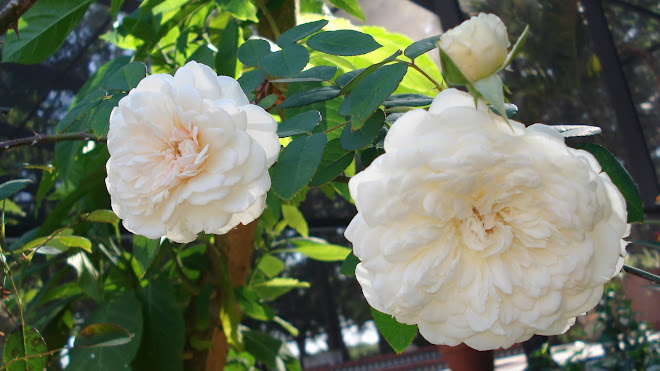
Welcome to my zone 9 garden. My roots are deeply planted in the sandy soil of sub-tropical central Florida, where the summers are long and hot, but the rest of the year is paradise!

Sunday, August 16, 2009

Wildlife Around the Garden

This Anhinga hangs his wings out to dry in the sun. He's perched atop a tree that was blown into the lake during a hurricane back in 2005. We had three storms that summer, and I can't recall which one toppled this tree. Turtles also love to sunbathe on the trunk of this tree.


And the Great Blue Heron also uses this same branch for a perch. Now the branch is just barely out of the water due to so much rain this summer.


Our resident red-shouldered hawk sits on the peak of our house scouting out his next meal. This past spring he hunted continuously, and we suspected that he had a brood of young'uns to feed. Now he is less visible. He's great at keeping the snake population down, but we've also seen him carrying baby birds (ugh), squirrels, rodents and frogs. A gorgeous bird!


The Osprey circle over the water in search of their next meal.


And, here's a lazy gator sunbathing on the same fallen tree that the bird in the first photo sat on. Click on this photo to enlarge it, and you'll see that his mouth is open. Perhaps he's waiting for some unsuspecting creature to swim right in. Either that or I caught him in the middle of a yawn.


I couldn't leave this cute little "wild" animal photo out. She's our plant-crushing cat who just happens to fit perfectly inside this clay pot. Never mind the fern that's being flattened and squeezed to the side. Luckily, the plant survived this 7 lb. light-weight kitty.

Wednesday, August 05, 2009

Landscape Update - Front of House

The Gardening Gone Wild blog hosts a "Garden Bloggers Design Workshop" to share gardener's experiences in landscape design - what worked and what didn't work! I've been wanting to do an update on my new garden (2007), so I thought I would join in with her post.

2007 - I was fortunate to have a clean slate with this garden. My past gardens (5 all together) were already established and I tweaked them to include my favorites. But all of them had plants that needed trimming on a regular basis and that is one garden chore that I absolutely do not like. So I was determined not to plant any shrubs that needed haircuts.

One negative for this new garden was the soil. Florida is known for its sandy soils but this "builder's sand" was devoid of any organic materials. My first step was to enrich the soil with peat humus and compost.


I wanted to plant low-growing plants so that they wouldn't be growing up over the front porch. The finished design included: Indian hawthorne for its ease of care and pretty spring flowers, Fashion azaleas for their bright reddish-orange color and long-lasting bloom time (Oct thru April), Blue Daze for its mounding growth and blue flowers, African iris for its bloom and adaptability to poor soil, Bush Daisies for some yellow color in winter, a Tabebuia tree for beautiful yellow spring flowers and lots of variegated and regular liriope as a filler.
I was pleased with the overall look when I finished it, and amazed at how quickly everything grew in this very hot area with lackluster soil.

Now, two years later here's a look at the front flower bed and what worked and what didn't work.
What worked - the Indian hawthornes are lush and in need of a slight trim to keep them compact (I don't mind trimming things once a year), the Fashion Azaleas also have done well. I planted them in the shape of a triangle and they have grown together nicely to form a hedge like look. The liriope have all thrived as well. And the Tabebuia tree is growing faster than I had anticipated and looks great.

What didn't work - There were some dissapointments and some changes that had to be made. The biggest dissapointments were the Blue Daze and the Bush Daisies. After thriving at first, both seemed to begin to dieback and look rather unsightly, so I yanked them out and replaced the Blue Daze with more liriope and the Bush Daisies with crotons and purple pentas. So far the replacements are doing well.

The African iris performed well but I had to replace them with a lower growing plant (Blanket Flowers - Gallardia) because they were blocking the other plants from receiving water from the sprinkler system. I relocated them to a new location and planted the blanket flowers which I love, and they seem to thrive in the heat and humidity of a Florida summer. I also added two yellow knock-out roses in the center of the azaleas and they are making themselves right at home.
Even for gardeners who've been at it for awhile, it's still trial and error to see what looks good and what will perform in a particular area. But putting the design together, tweaking it and watching it develop is the best part of gardening!

Sunday, August 02, 2009

Back to School

My daughter's best-friend's mother (who knows I'm a gardener and also loves to garden herself) asked me this past spring, if I would be interested in helping her plant a memorial garden dedicated to two teachers who died during the school year.

I was a little hesitant because I already have two yards that keep me plenty busy, but I knew she'd be on her own if I didn't help out. So, we got busy digging up grass, shopping for and planting new butterfly plants. I'm happy to say that our ambitions spilled over onto the existing butterfly gardens as we spruced them up alongside students in the Environmental Club.

Here's a view from outside the chainlink fence looking into their existing butterfly sanctuary. You can see a bit (fence and arbor) of the new memorial garden in the background.


Following our extremely cold temps last winter the passionvines (and most of the other plants) were frozen to the ground. By May, they were back and producing beautiful passion flowers.


Below are a few photos of the new memorial garden. We added lots of butterfly plants including cosmos, pentas, marigolds, lantana, porterweed, as well as mammoth dill for the ladybugs.


We even added a section for the senses. There are a variety of fragrant herbs and textures in these beautiful planters that were in the existing garden but not in use. It took a mob of us to move them into location, even after we emptied the dirt out of them.


The children in the school painted clay tiles (small and large) as a tribute to the teachers and we glued them to several painted posts throughout the garden. One family contributed this wonderful butterfly that was (I think) the perfect addition.


We were oh, so lucky that the birds were messy eaters as their scattered sunflower seeds began to sprout all over the existing butterfly garden. They were a great addition for the kids and we were (again) lucky that they bloomed before the end of the school year. Also, included in this photo is beach sunflowers which also came back with abandon following the freeze and some red fountain grass.


This is a view of the existing garden from inside the chainlink fence.


The children also grow a mixture of flowers and vegetables, some in hydroponic containers and others in raised beds.


This year they planted lots of zinnias, alongside their three-sisters garden (corn, beans & squash).


They enjoyed great success with their peppers, green beans, radishes & tomatoes. The teacher believes it was the "worm juice" she harvested from her wormbins that made the difference. It was a true joy to see the kids picking their harvest and snacking on it as they worked.


So, now that we are into the month of August, you can be assured that I am looking forward to going "back to school" to see how the garden fared through the hot summer, and to help get it ready for the fall planting. I am glad I said "yes" to helping out with this project. It was so much fun and very rewarding!

Saturday, July 04, 2009

Ferns & Mosses

Ferns are just one of those elegant types of plants - simple yet very artistic, especially when a new frond unfurls. This particular fern is from the Black Hammock in Oviedo, supposedly one of the few places that it grows in the world.

Here's a close up shot at the frond. We've had it in a pot for 19 years and it has only produced one other plant which is unusual for ferns.

It doesn't usually take ferns very long to fill in a bare spot in a shady garden. I purchased this silvery fern at Bok Tower Gardens in Winter Haven. I love the color of it and the long slender leaves, as well.

One of my favorite ferns is the Holly fern. It has beautiful glossy leaves and a nice round growth habit. And best of all it doesn't intrude on its neighbors by spreading uncontrollably.

This fishtail fern was a gift and we keep it potted because it does spread uncontrollably! But it is a lovely large fern.

Most ferns in my garden have just suddenly appeared on their own volition, like this unknown one that popped up among the bromeliads. I suppose having blown in on the wind from a neighboring yard. I have a hard time keeping "unknown" ferns out of my potted plants, in fact it's almost downright impossible.
The Resurrection Fern blankets the arm of a large Live oak in our backyard. This fern appears on its own and can be found in most oaks in Florida. It is truly a "magical" plant. When the weather is dry this fern is completely brown and all dried up, but following a rainshower it "magically" springs back to life, looking lush and green once again. I never cease to be amazed by the resiliency of this fern.

Ferns have a habit of showing up in very unusual places like between the pool tile, and

the outside stucco wall of our pool area. They are so pretty that I have a hard time plucking them out. I remember when we toured Volcano National Park in Hawaii sometime back, they told us the first plant to return to an area after an eruption is ferns.

They are so delicate and lacy, but they can also be bold and large here in Florida. This staghorn fern dangling from an elm tree is quite old and has survived many mornings as the temperatures hovered around the 32 degree mark. To protect our staghorn ferns from freezing, we wrap old sheets and blankets around them. In the dark they look like large ghosts swinging from the trees.


This particular one has very long slender leaves,
while its neighbor, a shorter but more stalky variety

has thick, bulky leaves. Keeping Spanish moss and live oak seedlings out of them can become a challenge, and it's hard to water them without the wind blowing a spray of water back into your face. But they do look beautiful swinging 'neath the large oaks and elm tree.


And, speaking of Spanish Moss, it is one of my favorite plants. You can't have a Live oak without Spanish moss draped across its branches. It's what creates that timeless, romantic and quiet dusty backroads feeling of the "Old South."

I know of lot of people have it removed or sprayed which I think is dreadful. It's so otherworldly looking and unique to the South. And, yes we do have to pick it up off the ground frequently as it is blown down by thunderstorms and wind. And, no I've never gotten "red bug" a/k/a chiggers or no-see-ums bites from picking it up. It does, however, make a great mulch that keeps weeds from penetrating its dense surface when wet and packed down on the ground.

With our frequent showers and high humidity, green moss grows with ease on outdoor pots, patios, bricks - you name it, it grows there. And, it is most welcome in my yard. This little bit of moss is finding a home on a brick walkway. My mother has a small patio tucked into a shady corner of her garden and it is completely covered by the mossy green growth. It is absolutely beautiful and looks right out of a fairy tale.

I placed this piece of moss (actually glued it) on this chair in the hopes that it would begin to cover it. I found it growing on the surface of some potted purslane. Ferns and mosses are two carefree plants that add a lot of interest and texture to a shady garden.

Tuesday, June 30, 2009

A Bird's Eye View

One nice thing about living in a two-story house is that you can look down on your garden for a whole different perspective. From this bird's eye view I can see how my color combinations are working, and where I need to place another plant. You know, I'm always looking for where another plant might fit! :-)

This area is my most favorite spot in the yard. There's usually a nice breeze coming off the lake as I sit on this deck shaded by several live oaks. That old chartreuse colored adirondak chair is just for looks these days. It is slowly rotting away but I just love the color it adds to the garden, so I'm sure to warn any visitors not to sit in it. A friend just recently suggested covering it with bromeliads which I thought was a great idea.
That large plant was here when we arrived. I have no idea what it is but I love it. It weathered temps down into the upper 2o's this past winter as did the bromeliads. This area seems to have a special micro-climate that protects my tropical beauties.

The top portion of this section belongs to my neighbor. We share a joint flowerbed. He knows how to landscape with ti plants. Usually people have one here and one there but this large bed of them is stunning. And, those lady palms just love the shade!
So now, I know what the birds see from their perch high up in the old oak tree.

Monday, June 22, 2009

Queen of the Dark

My neighbor, Nancy, called me at 9 pm last night and invited me over to look at her cactus flower. Well, I already had my p.j.'s on and was hesitant about changing and going out in the 84 degree still-heat of the night, but I said I'd be right over. And boy, am I ever glad I did. It was no ordinary "cactus flower." This giant, night-blooming cactus is astonishingly beautiful and awesome!
I took a photo on the top of my cooktop so that you get an idea of the size of this beauty. I'll be quiet now, so that you can admire this stunning flower in all its glory, whose beauty is reserved only for creatures of the night.


This cactus is a vine that sprawls high up in her Live oak trees. It begins to open around 9 pm and closes prior to dawn. What a shame that this magnificent flower is missed by humans.


Popular Posts


Related Posts with Thumbnails